Guayo - instrument
The guayo is a metal scraper used in Cuban folk and popular music, most commonly associated with changüí and early son from the Guantánamo region in eastern Cuba.
What It Is
The guayo is essentially a cylindrical metal grater — the same kitchen grater used for grating food — scraped rhythmically with a metal rod, fork, or stick. It produces a dry, rasping, metallic sound that cuts through the ensemble.
It is the metal counterpart of the wooden güiro and produces a harsher, more percussive timbre.
Origins
The guayo came out of rural eastern Cuba, where peasants and workers repurposed household objects as instruments. It is central to changüí, the oldest known cousin of son, from Guantánamo province.
Role in the Music
In changüí, the guayo provides a steady rhythmic layer alongside the tres, bongo, marímbula or bass, and maracas. It fills the role the güiro plays in charanga — constant rhythmic texture and groove maintenance.
As son moved west toward Havana and became more urbanized, the metal guayo was largely replaced by the wooden güiro in charanga-style ensembles. But in authentic changüí and traditional eastern Cuban son, the guayo remains the scraper of choice.
The guayo is not typically used in modern timba ensembles, but its lineage is present: its rhythmic scraping role has been absorbed into the modern percussion section, and its sound can still be heard in recordings that reference eastern Cuban roots.
Danzón was the first national dance of Cuba — the form that unified the island's popular music identity in the late 19th and early 20th century, and the ancestor of mambo, cha-cha-chá, and ultimately timba.
Lees meer >Timba is the music this site is dedicated to exploring. It emerged as a distinct genre in the late 1980s and crystallized in the early 1990s — born in a moment of social crisis, built on the full accumulated history of Cuban music, and still evolving today.
Lees meer >Rumba is the most African-rooted of all Cuban music and dance forms — born in the streets, courtyards, and docks of Havana and Matanzas in the late 19th century, with no European instruments, no salon setting, and no pretense of European propriety.
Lees meer >Before son, before danzón, before any of the named genres — there was Nengón and Changüí in the mountains and valleys of eastern Cuba (Oriente, especially Guantánamo province). These are the oldest surviving roots of Cuban popular music.
Lees meer >Cuba is the largest island in the Caribbean and the birthplace of some of the world's most influential music and dance traditions. African, Spanish, and French cultural streams collided here over centuries of colonial history, producing an extraordinary creative culture that exported itself across the globe.
Lees meer >The Casa de la Trova in Santiago de Cuba is the spiritual home of Cuban traditional music — Son, Bolero, Changüí, and Trova. Founded in 1968 on Calle Heredia in the heart of Santiago's historic center, it has been the gathering place for the city's musicians for over half a century.
Lees meer >Cuban music is built on percussion. The extraordinary density and variety of Cuban rhythmic culture reflects the meeting of West and Central African drumming traditions with Spanish, Haitian, and creole musical practices over four centuries. The instruments below form the core percussive vocabulary heard across Son, Rumba, Timba, Danzón, and their descendants.
Lees meer >
The bongo is a pair of small open-bottomed drums played with fingers and palms. It originated in eastern Cuba and became one of the defining percussion voices of son and timba.
Lees meer >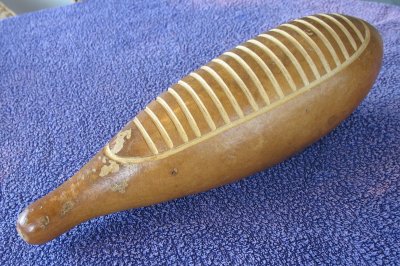
The güiro is a notched gourd scraped with a stick or fork to produce a rasping, rhythmic sound. It is a standard feature of charanga orchestras and is central to danzón, cha-cha-chá, son, and salsa.
Lees meer >The guayo is a metal scraper used in Cuban folk and popular music, most commonly associated with changüí and early son from the Guantánamo region in eastern Cuba.
Lees meer >
The marímbula is an Afro-Cuban bass instrument derived from African lamellophones (thumb pianos). It provided the bass voice in early son ensembles before being replaced by the upright bass.
Lees meer >
The tres is a Cuban guitar-like instrument with three pairs (courses) of strings. It is the defining melodic-rhythmic instrument of son cubano and its ancestor genres.
Lees meer > Timba, the explosive and rhythmically rich genre of Cuban dance music, transformed how the bass functions in popular music. In Timba, the bass is not just foundational — it’s fiery, funky, and free.
Lees meer >A Cuban popular dance music genre that emerged in the 1980s–90s
- emerged in the 1980s–90s
- influenced by songo, rumba, funk, blues, jazz, pop, rock and Afro-Cuban rhythms.
- Known for complex rhythm shifts, aggressive bass lines, and high energy that push dancers to improvise.
Lees meer >