Cuba and Its Music: From the First Drums to the Mambo - book
Ned Sublette | 2004 | Chicago Review Press | English
The most comprehensive English-language history of Cuban music ever written — from the earliest Indigenous and African music in Cuba through the mambo era. Required reading for anyone who wants to understand where timba comes from.
What It Covers
Ned Sublette spent decades researching this book, and it shows. Starting from Cuba's colonial origins and the arrival of African slaves, he traces every major development in Cuban music through meticulous historical research and vivid storytelling:
- The African nations that arrived in Cuba and the distinct musical traditions each brought
- The development of Afro-Cuban religious music ( batá drums, Santería, Abakuá)
- The formation of the contradanza, danza, and danzón traditions
- The birth and spread of son — the most detailed account available in English
- The conjunto era (Arsenio Rodríguez) and the roots of salsa
- The mambo revolution (Pérez Prado, Tito Puente, the Palladium)
- The social and political history that shaped every musical development
Why Dancers Should Read It
Everything in Cuban dance makes more sense with historical context. When you know that the habanera rhythm was African influence seeping into European salon music, that the son septeto's trumpet was the "seventh voice" that transformed the ensemble, that the Palladium Ballroom was where Cuban and Puerto Rican musicians played for desegregated audiences for the first time — the music and the dance become richer.
This is the book that connects the dots between all the genres you encounter as a Cuban dancer. After reading it, you understand the thread from Changüí to timba not as isolated facts but as a living story.
Note
The book covers up to the mambo era. It does not cover songo or timba directly (a second volume was planned but not published). For the timba era specifically, Kevin Moore's Beyond Salsa and his website timba.com fill that gap.
About the Author
Ned Sublette is an American musician, producer, and writer who has worked extensively with Cuban artists. His deep personal connection to the music gives the book warmth and authority beyond pure scholarship.
La danza fue el paso evolutivo entre la contradanza y el danzón — un baile de pareja más íntimo y más cubanizado que dominó los salones habaneros en la segunda mitad del siglo XIX.
Lees meer >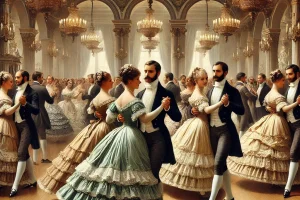
La contradanza fue la primera forma de danza de origen europeo que echó raíces en Cuba y comenzó a transformarse bajo la influencia africana. Es el punto de partida del linaje del baile de salón cubano que eventualmente produciría el danzón, el mambo y el cha-cha-chá.
Lees meer >
La contradanza fue la primera forma de danza de origen europeo que echó raíces en Cuba y comenzó a transformarse bajo la influencia africana. Es el punto de partida del linaje del baile de salón cubano que eventualmente produciría el danzón, el mambo y el cha-cha-chá.
Lees meer >El danzón fue el primer baile nacional de Cuba — la forma que unificó la identidad de la música popular cubana a finales del siglo XIX y principios del XX, y el antepasado del mambo, el cha-cha-chá y, en última instancia, la timba.
Lees meer > Timba is the music this site is dedicated to exploring. It emerged as a distinct genre in the late 1980s and crystallized in the early 1990s — born in a moment of social crisis, built on the full accumulated history of Cuban music, and still evolving today.
Lees meer >El Songo es el puente directo entre la música cubana tradicional y la timba. Desarrollado por Los Van Van a principios de los años 70, recableó la música popular cubana al absorber el funk, el rock y el jazz en la base rítmica afrocubana — y sentó todos los cimientos sobre los que la timba habría de construirse.
Lees meer > Cuba is the largest island in the Caribbean and the birthplace of some of the world's most influential music and dance traditions. African, Spanish, and French cultural streams collided here over centuries of colonial history, producing an extraordinary creative culture that exported itself across the globe.
Lees meer >Los tambores batá son un conjunto de tres tambores de doble parche en forma de reloj de arena, centrales en la tradición religiosa yoruba y en la música sacra afrocubana (Lucumí / Santería).
Lees meer >La trompeta ha sido central en la música popular cubana desde los años 20, cuando se convirtió en la voz melódica principal del septeto de son — la "séptima voz" que transformó el conjunto.
Lees meer >Un género de música popular bailable cubana que surgió en los años 1980–90
- Surgió en los años 1980–90
- Influenciado por el songo, la rumba, el funk, el blues, el jazz, el pop, el rock y los ritmos afrocubanos.
- Conocido por sus complejos cambios de ritmo, líneas de bajo agresivas y alta energía que impulsan a los bailadores a improvisar.
Lees meer >Mambo
En la música cubana, especialmente en la salsa y el son,
la sección de "mambo" generalmente se refiere a una pausa instrumental intensa y rítmicamente potente,
que a menudo presenta líneas de metales repetitivas, patrones de call-and-response y energía que va aumentando hacia el clímax de una canción.
The Casa de la Trova in Santiago de Cuba is the spiritual home of Cuban traditional music — Son, Bolero, Changüí, and Trova. Founded in 1968 on Calle Heredia in the heart of Santiago's historic center, it has been the gathering place for the city's musicians for over half a century.
Lees meer >