Cuba and Its Music: From the First Drums to the Mambo - book
Ned Sublette | 2004 | Chicago Review Press | English
The most comprehensive English-language history of Cuban music ever written — from the earliest Indigenous and African music in Cuba through the mambo era. Required reading for anyone who wants to understand where timba comes from.
What It Covers
Ned Sublette spent decades researching this book, and it shows. Starting from Cuba's colonial origins and the arrival of African slaves, he traces every major development in Cuban music through meticulous historical research and vivid storytelling:
- The African nations that arrived in Cuba and the distinct musical traditions each brought
- The development of Afro-Cuban religious music ( batá drums, Santería, Abakuá)
- The formation of the contradanza, danza, and danzón traditions
- The birth and spread of son — the most detailed account available in English
- The conjunto era (Arsenio Rodríguez) and the roots of salsa
- The mambo revolution (Pérez Prado, Tito Puente, the Palladium)
- The social and political history that shaped every musical development
Why Dancers Should Read It
Everything in Cuban dance makes more sense with historical context. When you know that the habanera rhythm was African influence seeping into European salon music, that the son septeto's trumpet was the "seventh voice" that transformed the ensemble, that the Palladium Ballroom was where Cuban and Puerto Rican musicians played for desegregated audiences for the first time — the music and the dance become richer.
This is the book that connects the dots between all the genres you encounter as a Cuban dancer. After reading it, you understand the thread from Changüí to timba not as isolated facts but as a living story.
Note
The book covers up to the mambo era. It does not cover songo or timba directly (a second volume was planned but not published). For the timba era specifically, Kevin Moore's Beyond Salsa and his website timba.com fill that gap.
About the Author
Ned Sublette is an American musician, producer, and writer who has worked extensively with Cuban artists. His deep personal connection to the music gives the book warmth and authority beyond pure scholarship.
De danza was de evolutionaire stap tussen de contradanza en de danzón — een intiemere, meer Cubaans geworden paardans die in de tweede helft van de 19e eeuw de salons van Havana domineerde.
Lees meer >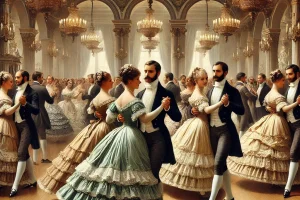
De contradanza was de eerste Europees-afgeleide dansvorm die wortel schoot in Cuba en begon te transformeren onder Afrikaanse invloed. Het is het beginpunt van de Cubaanse salondanslijn die uiteindelijk danzón, mambo en cha-cha-chá zou voortbrengen.
Lees meer >
De contradanza was de eerste Europees-afgeleide dansvorm die wortel schoot in Cuba en begon te transformeren onder Afrikaanse invloed. Het is het beginpunt van de Cubaanse salondanslijn die uiteindelijk danzón, mambo en cha-cha-chá zou voortbrengen.
Lees meer >Danzón was de eerste nationale dans van Cuba — de vorm die in de late 19e en vroege 20e eeuw de identiteit van de Cubaanse populaire muziek verenigde, en de voorloper van mambo, cha-cha-chá en uiteindelijk timba.
Lees meer > Timba is the music this site is dedicated to exploring. It emerged as a distinct genre in the late 1980s and crystallized in the early 1990s — born in a moment of social crisis, built on the full accumulated history of Cuban music, and still evolving today.
Lees meer >Songo is de directe brug tussen traditionele Cubaanse muziek en timba. Ontwikkeld door Los Van Van in het vroege 1970, bedraadde het de Cubaanse populaire muziek opnieuw door funk, rock en jazz te absorberen in de Afro-Cubaanse ritmische basis — en legde alle grondslagen waarop timba zou voortbouwen.
Lees meer > Cuba is the largest island in the Caribbean and the birthplace of some of the world's most influential music and dance traditions. African, Spanish, and French cultural streams collided here over centuries of colonial history, producing an extraordinary creative culture that exported itself across the globe.
Lees meer >De batá-trommels zijn een set van drie dubbelzijdige, zandlopervormige trommels die centraal staan in de Yoruba-religieuze traditie en de Afro-Cubaanse sacrale muziek (Lucumí / Santería).
Lees meer >De trompet staat centraal in de Cubaanse populaire muziek sinds de jaren 20, toen het de belangrijkste melodische stem werd van het son-septeto — de "zevende stem" die het ensemble transformeerde.
Lees meer >Een Cubaans populair dansmuziekgenre dat ontstond in de jaren 1980–90
- Ontstaan in de jaren 1980–90
- Beïnvloed door songo, rumba, funk, blues, jazz, pop, rock en Afro-Cubaanse ritmes.
- Bekend om complexe ritmewisselingen, agressieve baslijnen en hoge energie die dansers aanzet tot improvisatie.
Lees meer >Mambo
In Cubaanse muziek, met name in salsa en son,
verwijst het "mambo"-gedeelte doorgaans naar een krachtige, ritmisch intense instrumentale break,
die vaak repetitieve hoornlijnen, call-and-response-patronen en opbouwende energie naar het hoogtepunt van een nummer bevat.
The Casa de la Trova in Santiago de Cuba is the spiritual home of Cuban traditional music — Son, Bolero, Changüí, and Trova. Founded in 1968 on Calle Heredia in the heart of Santiago's historic center, it has been the gathering place for the city's musicians for over half a century.
Lees meer >